Students will learn about the primary positions in professional soccer and identify the roles and responsibilities associated with each position.

No information available.
Students will learn about the primary positions in professional soccer and identify the roles and responsibilities associated with each position.
In professional soccer, player positions are crucial for team strategy and success, as each position has specific responsibilities that contribute to both offensive and defensive play. Proper positioning allows teams to maximize their strengths, maintain balance on the field, and effectively counter their opponents.
● Worksheet pg. 4
● Start the lesson by leading students in a short discussion to assess what they already know about player positions in soccer.
Use the questions provided as a jumping-off point, or come up with your own.
● Explain to students that they will learn about the various player positions in soccer and the importance of player positions in team strategy.
● Explain each of the positions below. You can choose to keep this simple with a general overview of each position or go a little more in-depth about each position.
Goalkeeper (GK):
Their primary role is to protect the goal and prevent the opposing team from scoring.
They can use their hands within the penalty area, and they wear different-colored jerseys.
Defenders:
Center Backs (CB): They protect the area in front of the goal, block shots, and clear the ball.
Full Backs (LB/RB): They play on the left and right flanks, support both defense and attack and are often involved in marking opposing wingers.
Wingbacks (LWB/RWB): They are more attack-oriented fullbacks, often seen in formations that use three-center backs.
Midfielders:
Central Midfielders (CM): Link between defense and attack, involved in both defensive and offensive play.
Defensive Midfielders (CDM): Primarily focused on breaking up opposition attacks and protecting the defense.
Attacking Midfielders (CAM): Focused on creating scoring opportunities, often positioned behind the forwards.
Forwards:
Strikers (ST): Main goal scorers, positioned closest to the opponent's goal.
Wingers (LW/RW): They play on the left and right flanks and are responsible for delivering crosses, scoring goals, and assisting in defense.
● Show students the video below, then lead them in a short discussion about what they observed in the video
No information available.
Roles and responsibilities of player positions:
Explain that the team strategy plays an important role in the game.
Different formations of the players utilize player positions differently to implement various strategies during play.
Discuss the importance of positioning in attack and defense, movement without the ball, and teamwork.
Encourage students to compare the use of position and strategy of soccer to other sports.
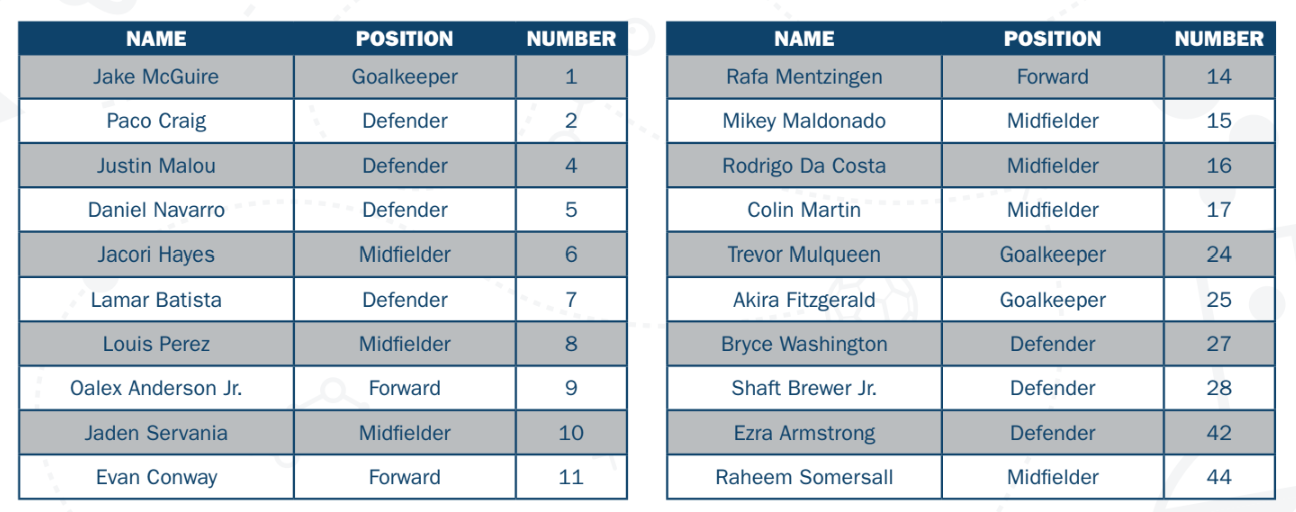
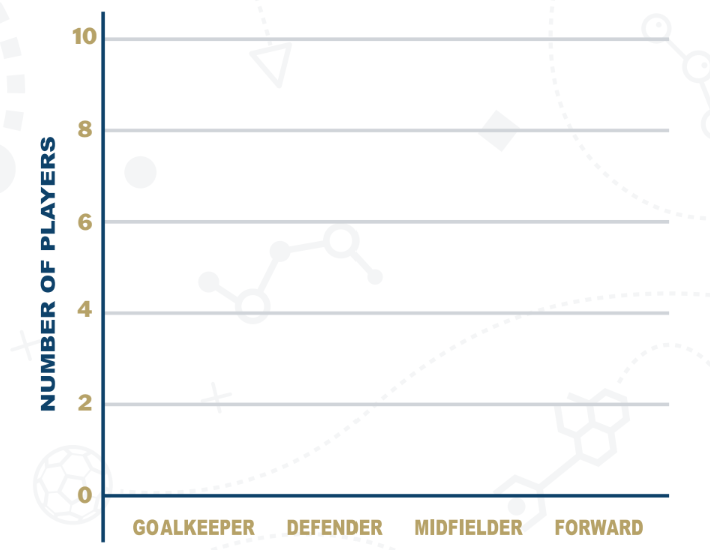
● Have students complete the worksheet activity using the current team roster.
They will create a bar graph representing the number of players for each position on the team and answer questions about the various numbers of players in each position.
Additional activity suggestion:
● Turn this into a game where students have to match the player's position with the description.
● Allow students time to play a mini-soccer game where they try out different player positions.
● Students can research their favorite players and the positions they play.
Discussion Questions:
● What position would you like to play if you were on a soccer team, and why?
● What are the different player positions in soccer?
● How do the different positions on a soccer team work together to achieve common goals?
Reflection Questions:
● Why is it important for players to understand and specialize in specific positions?
● How can a player's skills and attributes influence the position they play?
● What challenges might a player face when switching positions?
No information available.
No information available.
No information available.
Grade 6
PE 2.3.6 Demonstrate transitions from offense to defense or defense to offense by recovering quickly.
Grade 7
PE 2.3.7 Demonstrate transitions from defense to offense or offense to defense by recovering quickly and communicating with teammates.
Grade 8
PE 2.3.8 Demonstrate transitions from offense to defense or defense to offense by recovering quickly and communicating with teammates, and capitalizing on an advantage.



